
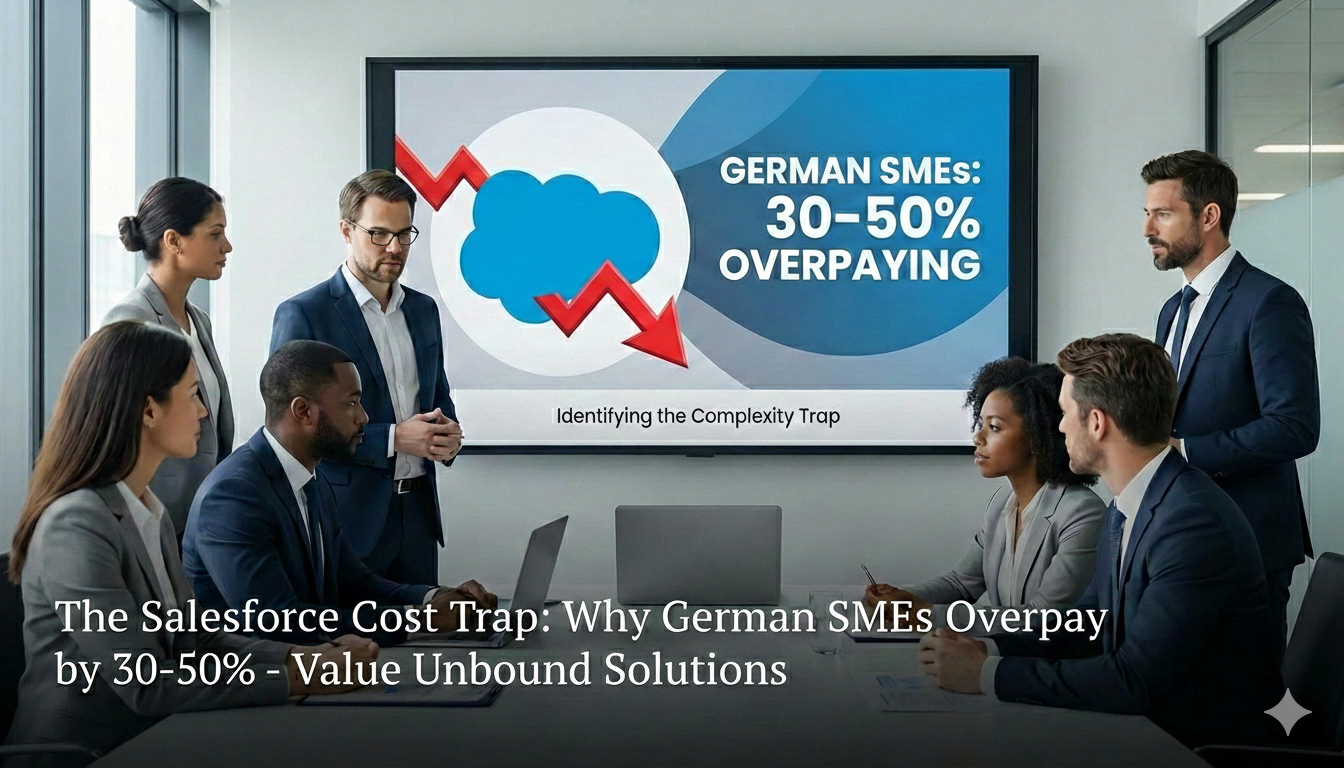
The Hidden Cost of Salesforce Complexity
Salesforce is the world's leading CRM platform, and for good reason. It's powerful, flexible, and extensible. But that very flexibility comes with a hidden cost that most German SMEs don't recognize until it's too late: the complexity trap.
After 15 years of working with enterprise Salesforce implementations across the US, UK, and Europe, I've seen the same pattern repeat itself hundreds of times. A company starts with a straightforward Salesforce deployment. Over time, features get added, licenses get upgraded, and custom solutions get layered on top. Before anyone notices, the annual Salesforce bill has grown 3-5x while actual usage remains flat.
The average German SME uses only 40-60% of the Salesforce features they're paying for. The rest is expensive shelf-ware that adds complexity without adding value.
Why German SMEs Are Particularly Vulnerable
German mid-market companies face unique challenges when it comes to Salesforce costs. Unlike large enterprises with dedicated Salesforce administrators and architects, most Mittelstand companies rely on external consultants or part-time administrators who may not have the expertise to optimize license allocation.
The Four Root Causes of Overspending
- License Over-Provisioning: Companies purchase Enterprise Edition licenses for users who only need Sales Professional or even Platform licenses. A single Enterprise license costs significantly more per user per month than what most employees actually require.
- Feature Bloat: Salesforce bundles features that sound compelling during sales presentations but rarely get used in practice. Features like Einstein Analytics, CPQ, or Service Cloud are powerful, but if your team isn't using them, you're paying for expensive shelf-ware.
- Integration Overhead: Custom integrations built over years create dependencies that make it difficult to downgrade or simplify. The perceived cost of changing becomes a barrier to optimization.
- Contract Lock-In: Multi-year contracts with automatic renewal and built-in price increases compound the problem. Many companies don't review their Salesforce spend until renewal time, by which point the complexity is deeply embedded.
How to Identify If You're Overpaying
There are several warning signs that your Salesforce implementation has fallen into the cost trap. If any of these sound familiar, it's time for an optimization review:
- Your Salesforce bill has grown more than 20% year-over-year without a corresponding increase in users or revenue
- More than 30% of your licensed users log in less than once a week
- You have Salesforce features enabled that no one on your team can explain
- Your admin team spends more time managing Salesforce than improving it
- You've been on the same license tier for more than 2 years without reviewing alternatives
- Custom objects and fields have accumulated beyond what your business processes require
The 5-Step Optimization Framework
At Value Unbound Solutions, we use a systematic approach to identify and eliminate Salesforce waste while maintaining full business continuity. Here's how the process works:
Step 1: Usage Audit
We analyze actual login patterns, feature usage, and data flows across your entire Salesforce org. This reveals the gap between what you're paying for and what you're actually using. Most companies are surprised to find that 30-50% of their licensed features go completely untouched.
Step 2: License Rightsizing
Based on the usage audit, we map each user to the most cost-effective license type that still meets their needs. This often means moving users from Enterprise to Professional or Platform licenses, which can reduce per-user costs by 40-60%.
Step 3: Feature Rationalization
We identify which premium features are delivering value and which are shelf-ware. Features that aren't being used get flagged for removal at the next contract renewal. Features that could be replaced by simpler, cheaper alternatives get documented with migration plans.
Step 4: Integration Simplification
Complex custom integrations are often the biggest hidden cost. We evaluate each integration for necessity and efficiency, recommending consolidation or replacement where appropriate. Modern integration platforms can often replace custom-built solutions at a fraction of the maintenance cost.
Step 5: Contract Negotiation Strategy
Armed with concrete data on your actual usage and optimized requirements, we help you negotiate better terms at renewal. This includes right-sizing the contract, removing unused features, and leveraging competitive pressure to secure better pricing.
Real Results: What Optimization Looks Like
The results of a systematic Salesforce optimization are typically significant and immediate. Based on our experience with German SMEs:
- 20-40% reduction in annual Salesforce licensing costs
- 50-70% reduction in admin overhead through simplified configurations
- Higher user adoption as the system becomes simpler and more focused
- Better ROI tracking with clearer metrics on what Salesforce delivers
AI and the Future of Salesforce Cost Management
Artificial intelligence is transforming how companies manage their CRM investments. AI-powered tools can now continuously monitor Salesforce usage patterns, automatically identify optimization opportunities, and even predict when licenses will become underutilized before it happens.
At Value Unbound Solutions, we're building AI-powered tools that make Salesforce optimization an ongoing process rather than a one-time audit. These tools analyze your usage data in real-time and provide actionable recommendations that keep your Salesforce investment aligned with your actual business needs.
Getting Started
If you suspect your company is overpaying for Salesforce, the first step is a complimentary assessment. In just 30 minutes, we can review your current setup and identify the top 3-5 optimization opportunities. There's no commitment required, and you'll walk away with concrete, actionable insights regardless of whether you choose to work with us.
The Salesforce cost trap is real, but it's entirely escapable. With the right expertise and a systematic approach, German SMEs can reclaim 30-50% of their CRM budget while actually improving their Salesforce experience.
Ready to Optimize Your Salesforce?
Schedule a free 30-minute assessment and discover how much you could save.
Start Free Assessment